- LEO is evolving from a niche space segment into a fast-scaling communications and compute platform. Reusable launch economics, mass-produced satellites, and new user terminals are driving a more global, semiconductor-intensive space economy.
- For STMicroelectronics, this is already a meaningful business, with a strong technology leadership position and a growth opportunity. ST’s manufacturing independence and its unique technologies and manufacturing capabilities have put it at the heart of the LEO ecosystem.
- ST is not just participating in LEO; it is one of the core enablers of the ecosystem, with a differentiated portfolio spanning every layer of LEO.
- The opportunity is substantial and expanding: the LEO SAM is expected to reach around $3 billion by 2030, roughly 4x versus 2025, while ST is targeting well above $3 billion of cumulative space revenue in 2026 to 2028.

By Remi El-Ouazzane, President, Microcontrollers, Digital ICs and RF products Group.
A new space economy is taking shape
The space industry can be seen as evolving along two broad paths. Traditional space includes geostationary and medium Earth orbit systems used for established applications such as broadcasting, meteorology, and GNSS. These programs are mission-critical, but they are characterized by large satellites, long development cycles, and highly predictable service models.
Low Earth orbit (LEO) is different. It is built around smaller satellites, much faster deployment, lower latency, and business models designed for mass adoption. This shift is not just about orbit altitude; it is about economics. LEO opens the door to broader connectivity, higher deployment volumes, and stronger semiconductor content per system.
That change has been enabled by three major technology inflections. First, launch costs have fallen dramatically thanks to reusable rockets. Second, satellites have become lighter, more standardized, and more digital, with software-defined payloads and inter-satellite optical links increasingly common. Third, user terminals have evolved from traditional parabolic antennas into electronically steered phased arrays capable of tracking fast-moving satellites with precision and reliability.
Together, these shifts have created an ecosystem where silicon content matters more than ever.
ST’s position: from early participation to market leadership
ST has been active in space for more than 45 years, with a long track record across both traditional and new space programs. In LEO, the company was involved from the beginning and has since become the leading semiconductor player in the market.
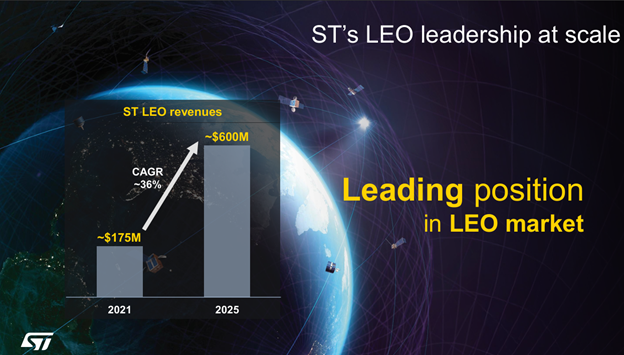
That leadership is already visible in the numbers. ST’s LEO-related revenue reached approximately $600 million in 2025, up from about $175 million in 2021, representing a CAGR of roughly 36%.
This is an impressive starting point, but the opportunity is still in its early innings. The market is expanding quickly, the customer base is broadening, and the underlying technology roadmap continues to deepen semiconductor content across satellites, gateways, and user terminals.
Why LEO is scaling so fast
The economics of LEO are being transformed by scale. Gartner estimates that LEO services spending will approach $15 billion globally in 2026. The growth is continuing across three major service categories: broadband, direct-to-cell, and eventually orbital data centers.
Broadband is the largest opportunity today. LEO constellations can connect underserved regions, improve resilience for corporate and government users, and provide connectivity for mobility applications such as aviation, maritime, and eventually automotive. In a world where almost 3 billion people remain on the wrong side of the digital divide, the importance of global broadband access is difficult to overstate.
The second growth engine is direct-to-cell, which enables phones and IoT devices to connect directly to satellites acting as cell towers in space. This expands connectivity into previously unreachable areas and opens growth in roaming-free services and asset tracking.
The third frontier is orbital data centers. While still early, the concept is gaining traction as the cost of launch per kilogram is reduced and the economics of putting compute in orbit become more credible.
A highly semiconductor-intensive ecosystem
Over the next five years, LEO will scale rapidly into a true communications ecosystem. Space-based downlink capacity is expected to grow around 10x by 2030, gateway infrastructure will expand by estimated 1.6x, and subscribers could rise from about 10 million today to more than 200 million.
LEO is not just a communications market. It is a semiconductor market. ST’s opportunity spans all three layers of the ecosystem:
• Satellites
• Gateways
• User terminals
Each layer has different technical requirements, but all rely on advanced silicon content. A key factor is the scale: the market is shipping thousands of satellites per year, thousands of gateways, and millions, eventually tens of millions, of user terminals. That combination creates a very large addressable market. Based on our current view, we estimate that LEO broadband electronics SAM was around $650 million in 2025, growing to roughly $2 billion in 2028 and close to $3 billion by 2030, excluding additional upside from orbital data centers.
Technology differentiation: where ST wins
ST’s competitive strength in LEO comes from the combination of our process technologies, packaging capabilities, and manufacturing scale.
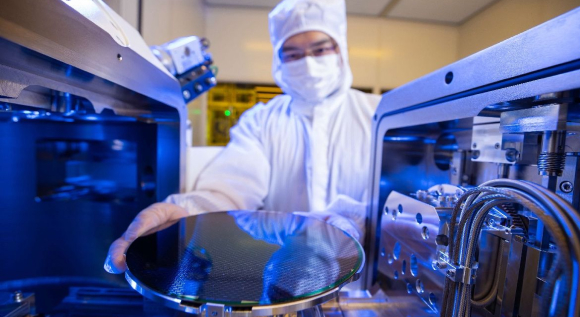
FD-SOI for satellites and microcontrollers: ST’s Fully Depleted Silicon On Insulator, or FD-SOI, supplied from our 300 mm fab in France and through foundry partnerships, is a key enabler for ASICs and microcontrollers in space systems. It offers a combination of performance, power efficiency, radiation robustness, and embedded memory capabilities. This matters because satellites need electronics that are reliable, efficient, and resilient in harsh conditions. In LEO, where platforms must be lighter and more integrated, these attributes are essential.
BiCMOS for user terminals: For user terminals, BiCMOS is the best technology on the planet for front-end modules. These modules perform signal amplification, transmit and receive switching, filtering, and phase shifting for beamforming. They are central to the cost, performance, and scalability of phased-array antennas. ST’s BiCMOS platform is especially strong in Ku-band cost-optimized designs and Ka-band performance designs, both served from our French manufacturing base.
Panel-Level Packaging: On the back end, ST’s Panel-Level Packaging, or PLP, is a genuine differentiator. Unlike traditional round-wafer packaging, PLP uses large rectangular panels, enabling high-volume production, strong RF and thermal performance, and miniaturization. The combination of BiCMOS and PLP is particularly powerful. Neither technology alone would be as compelling as the two together. This is a classic example of how our IDM model delivers technology excellence plus manufacturing execution.
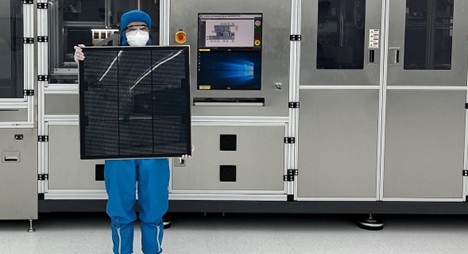
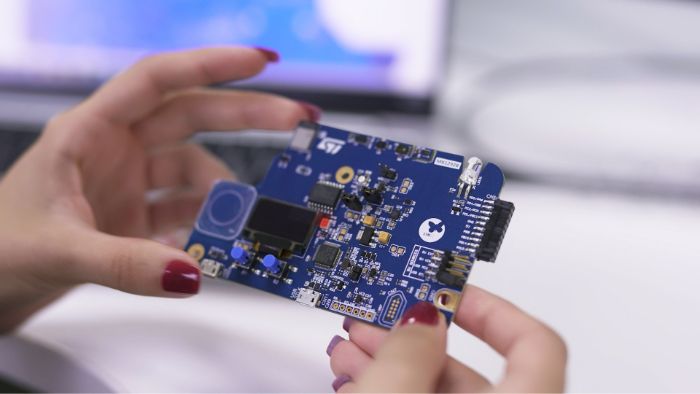
ST employee holding a BiCMOS PLP panel
Starlink as proof of scale
The clearest proof point for ST’s LEO capability is our long-standing collaboration with SpaceX. The relationship spans more than a decade and has involved co-development across key technologies for satellites and user terminals.
So far, we have delivered more than 7.5 billion ICs into the program, with active silicon covering roughly 20,000 square meters, or the equivalent of four American football fields. The scale is extraordinary, and it demonstrates that ST can support industrial-grade space programs at very high volume.
Economics, scale, and customer concentration
Today the LEO market remains relatively concentrated. In the next five years, more players may emerge with the scale and capital intensity to matter, including Amazon Leo (formerly ‘Project Kuiper’), Terawave, OneWeb, European projects, and new emerging constellations. This concentration creates both opportunity and discipline. We believe we can sustain a leading position because of our process integration, packaging capabilities, and manufacturing independence. Product life cycles in user terminals are also short, around 18 months per generation, which reinforces the importance of our IDM model with the capability for industrial scale, rapid ramp-up, and tight execution. This is precisely the kind of environment where our manufacturing model creates advantage.
The long-term ambition
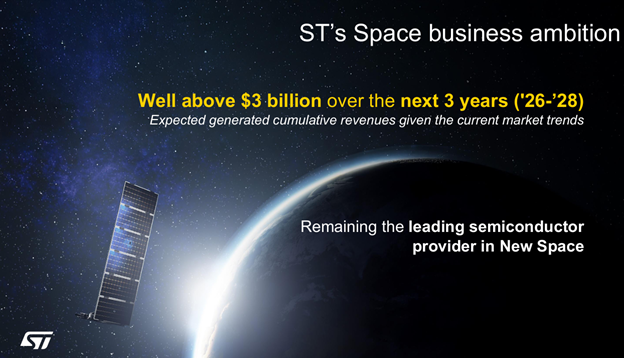
Our message is straightforward. We expect space to become a major growth driver, with an ambition to generate well above €3 billion in cumulative revenue from space over the 2026 to 2028 period. On the LEO side specifically, this includes broadband and direct-to-cell, with orbital data centers as potential upside. The broader significance is that ST is building a leadership position in a market that is only beginning to expand. LEO is no longer a niche space project. It is becoming a communications infrastructure layer, and eventually perhaps a compute layer, for the planet. For ST, the opportunity is not just about serving satellites. It is about supplying the technologies that make the new space economy scalable, efficient, and economically viable.
Presentation: ST: The LEO Opportunity
Language Versions