- STMicroelectronics is a core enabler of the Cloud AI era, supplying the optical technologies, power and connectivity that allow hyperscale AI data centers to scale from megawatts to gigawatts while moving more data with greater efficiency and less energy.
- While connectivity is mostly pluggable today, optical solutions are ramping fast, creating a major growth opportunity for next-generation architectures.
- From wide-bandgap silicon carbide (SiC) and gallium nitride (GaN) devices and 800 VDC architectures, to high-volume silicon photonics platforms deployed at leading hyperscalers and managed by STM32 microcontrollers and BiCMOS electronics, ST provides technologies that support grid-to-core deliveries, underpinning the next generation of AI factories.
- ST is supporting collaboration across the broad ecosystem, including research labs, ODMs, module vendors, and the largest hyperscalers.
- With current market dynamics, we believe ST can achieve revenue nicely above $500 million in 2026 and well above $1 billion in 2027.
 By Remi El-Ouazzane, President, Microcontrollers, Digital ICs and RF products Group, STMicroelectronics.
 By Marco Cassis, President, President, Analog, Power & Discrete, MEMS and Sensors Group, Head of STMicroelectronics’ Strategy, System Research and Applications, Innovation Office.
Cloud AI is redefining computing at extraordinary speed. As the world’s largest technology companies race to build AI at scale, the data center from the software and silicon to its power architecture, its networking fabric, and the fundamental physics of how information moves is being reimagined from the ground up. The shift toward accelerated workloads is a structural transformation, and it demands an entirely new generation of infrastructure.
Behind every model training run and inference cluster is a fundamental question: how do you deliver enough power, move enough data, and maintain efficiency and reliability as you scale from kilowatts to megawatts, and from megawatts to gigawatts? STMicroelectronics does not design GPUs or AI models. But we play a decisive role in answering that question providing the semiconductor technologies that make AI factories possible, linking the grid to the core through advanced power conversion, high-speed connectivity, and integrated optical interconnects.
The data center under pressure
The numbers define the challenge. Global data center capacity is projected to nearly double, from around 103 GW in 2025 to 200 GW by 2030, with annual infrastructure spending expected to exceed $1 trillion by the end of the decade. A few years ago, a powerful server rack drew 10 to 15 kW, roughly the load of several household ovens. In the AI era, operators are planning for 500 kW to more than 1 MW per rack: enough to power hundreds of homes. Meanwhile, the data traffic between accelerators is growing in proportion, as training and serving large models requires billions of data points to move between chips every second.
Legacy infrastructure was not built for this. Copper interconnects, once the backbone of data center networking, increasingly cannot meet the speed, reach, and energy-per-bit requirements of modern AI clusters. Traditional power architectures struggle with efficiency, thermal management, and physical footprint at megawatt densities. The result is rising costs, mounting complexity, and an industry-wide imperative to rethink how data centers are powered and connected.
From copper to light: silicon photonics in the AI fabric
The communication demands of large AI clusters have made traditional copper-based networking unsustainable at scale. Copper links struggle with attenuation and crosstalk at high speeds and across the distances needed to connect racks and rows. They also consume too much power per bit, a constraint that becomes critical when a single training cluster may contain tens of thousands of accelerators, all exchanging data continuously.
Optical interconnects are becoming the backbone of Cloud AI networks. Light carries more data with lower loss, over longer distances, and with better energy efficiency. For AI training and inference workloads, where job completion time and cluster utilisation depend directly on interconnect performance, this transition is transformational.
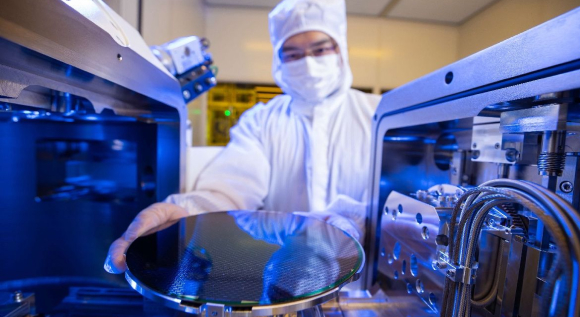
ST has invested deeply in silicon photonics to enable this shift. The PIC100 silicon photonics platform delivers high-speed, low-loss optical links for intra- and inter-data center applications. Produced on 300 mm wafers and already in high-volume production for leading hyperscalers, PIC100 gives operators a proven, scalable path to optical fabrics in AI deployments. Capacity for this platform is set to quadruple by 2027 and further expand in 2027, a reflection of the pace at which cloud providers are moving toward optical-first network architectures. This fast expansion is fully underpinned by customers’ long-term capacity reservation commitments.
Photonic integrated circuits are combined with custom electronics to create optical engines suited to the full range of deployment models: traditional pluggable modules, near-packaged optics positioned close to the switch or accelerator ASIC, and co-packaged optics where electro-optical integration is deepest. ST is developing PIC100 TSV, an architecture that increases connectivity density and improves thermal performance at the module and system level, targeting the near-packaged and co-packaged optics deployments that will define the next generation of AI switches and accelerator packages. Industry forecasts project silicon photonics growing from roughly a third to nearly two-thirds of all optical technologies used in AI clusters by 2030. ST is positioning to be at the center of that growth.
Intelligence at the edge of power and light
As AI clusters shift to optical connectivity, they also need an intelligent control layer to configure, monitor, and protect these systems in real time. Advanced power chains and optical fabrics are only as reliable as the intelligence managing them. Optical fibres cannot monitor their own signal integrity; power systems do not self-optimise across thousands of modules without intervention. Microcontrollers and mixed-signal ICs provide the control layer that makes large-scale infrastructure dependable.
Inside optical modules, STM32 high-performance microcontrollers act as local orchestrators configuring lasers and detectors, measuring temperature and voltage, exposing telemetry to host systems, and enabling modules to adapt in real time and protect against degradation. High-speed electronics built on ST’s BiCMOS B55X process technology sit alongside photonic waveguides, driving lasers and amplifying received signals at 100 Gbps, 200 Gbps, and beyond per lane, while remaining power-efficient enough for deployment in thermally constrained AI racks.
In the power path, intelligent controllers coordinate conversion stages, implement protection mechanisms, and optimise load sharing under varying operating conditions. Across a hyperscale data center, thousands of such devices collectively provide the visibility and control that Cloud AI infrastructure demands and that operators increasingly cannot do without.
From grid-to-core
ST supplies the critical semiconductors that power, cool, and connect AI data centers – supporting grid to core, and the core to the user addressing every major node in the Cloud AI chain:
Grid → solid-state transformer → 800 VDC distribution → power racks → core power stages → xPU/GPU → optical network
At each step, ST contributes specific, differentiated technology: wide-bandgap power devices and high-efficiency converters to move energy from the grid to the core; silicon photonics, BiCMOS electronics, and integrated optical engines to move data faster at lower power; and microcontrollers and mixed-signal ICs to manage, monitor, and orchestrate these systems in real time.
Powering the AI factory: SiC, GaN, and 800 VDC
AI workloads are fundamentally changing the power profile of data centers. Goldman Sachs estimates that total data center power demand will increase by around 165% between 2023 and 2030. To meet this demand efficiently, operators are migrating from traditional AC distribution and lower-voltage DC schemes to high-voltage DC topologies, with 800 VDC distribution emerging as the architecture of choice for next-generation AI campuses.
ST’s power technologies are designed for this reality. Silicon carbide devices address the high-voltage, high-efficiency conversion stages at the front end: grid interfaces, solid-state transformers, and HVDC distribution. Gallium nitride takes over closer to the load, where high-frequency, compact conversion enables dense power shelves and point-of-load regulators for GPUs, CPUs, and custom accelerators. Advanced controllers and low-voltage devices coordinate the full power path from 800 V down to 50 V, 12 V, 6 V, and below where modern chips operate.
Working with partners including NVIDIA, ST has developed a suite of 800 VDC power-conversion architectures aligned with NVIDIA’s reference designs for next-generation AI data centers. By reducing conversion stages and copper usage, and optimising efficiency across the chain, these solutions help hyperscalers deliver more usable power to more accelerators within the same physical footprint turning the 1 MW rack from an engineering challenge into an operational reality.
Building with the hyperscalers
Cloud AI is an ecosystem. A multiyear collaboration with Amazon Web Services sees ST supplying advanced connectivity ICs, mixed-signal devices, microcontrollers, and analog and power ICs integrated directly into AWS’s compute infrastructure. It is a model of deep, long-term engagement. ST’s work in high-voltage DC power architectures follows the same logic. By co-creating reference designs and validated solutions for 800 VDC distribution and conversion, ST helps accelerate the adoption of efficient, scalable power topologies across the industry not just for a single customer, but as a contribution to where the broader ecosystem is heading.
Beyond these anchor partnerships, ST engineers work with original design manufacturers, module vendors, and research institutions to help define the standards and implementation practices that will govern how these building blocks are deployed at scale.
Scaling the manufacturing engine
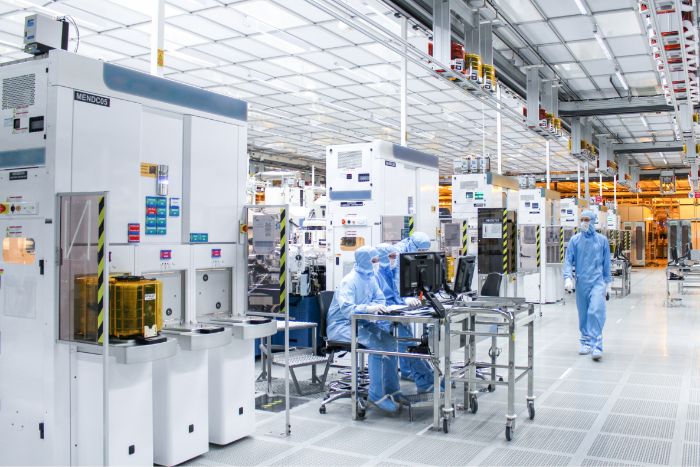
Technology leadership is only valuable when it can be delivered in volume. With AI capacity expanding rapidly across regions, ST’s manufacturing footprint is designed for the scale, resilience, and geographic proximity that hyperscalers require.
In Italy, high-volume 200 mm silicon carbide lines supply the high-voltage, high-efficiency devices at the heart of advanced power conversion. In France, our 300 mm fabs produce digital, mixed-signal, and silicon photonics technologies including the PIC100 platform — with a committed roadmap to quadruple photonics capacity by 2027. In China, a joint venture with Sanan Optoelectronics provides 200 mm SiC device manufacturing, securing local supply in one of the world’s fastest-growing data center markets.
This distributed model ensures that as Cloud AI deployment accelerates across geographies, the critical components SiC and GaN power devices, photonic ICs, BiCMOS drivers, microcontrollers are available where and when they are needed.
A long-term structural shift
The AI buildout is a structural shift in how computing is delivered and where value is created. Data centers are transitioning from megawatts to gigawatts, from AC to high-voltage DC, from copper to optical interconnects. Each of these inflections maps directly onto ST’s core competencies in connectivity, power, and control.
As Cloud AI deployments scale, this segment is expected to become a significant growth engine for ST with cloud AI infrastructure revenue projected to be nicely above $500 million in 2026 and well above $1 billion in 2027. But beyond the financial trajectory, the significance is structural: ST is helping to build a new layer of critical infrastructure for the digital world.
Powerful GPUs and sophisticated AI models may capture the headlines. But their performance and the economic value they generate depends on a less visible foundation of optical connectivity, power conversion, and real-time control.
ST is building that foundation, systematically, from the grid to the core, so that the next generation of AI factories can operate at the efficiency, density, and scale that the world’s demand for intelligence requires.
Presentation: ST Cloud AI update
Language Versions